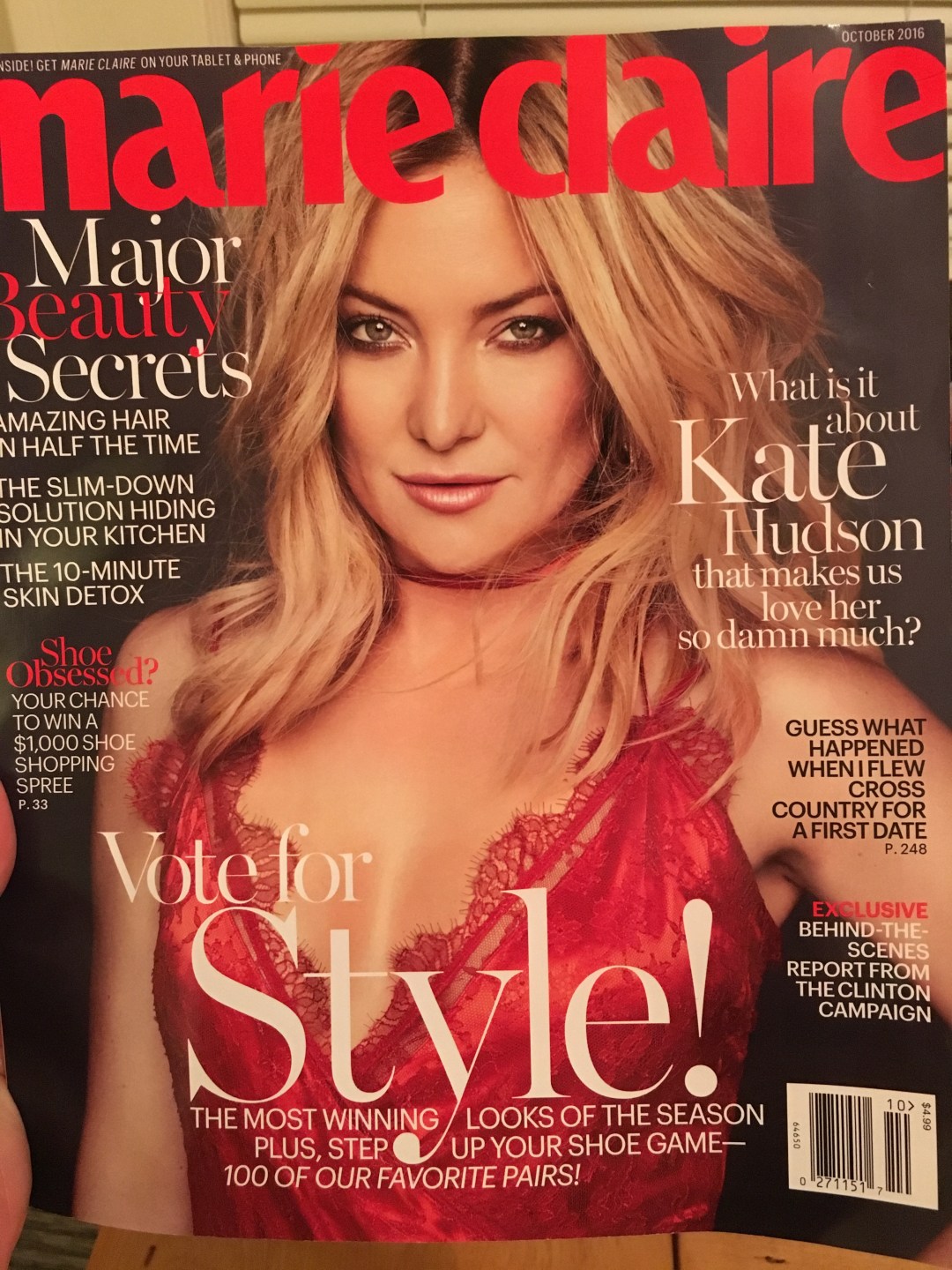
(cover story appears on page 230 of 256)
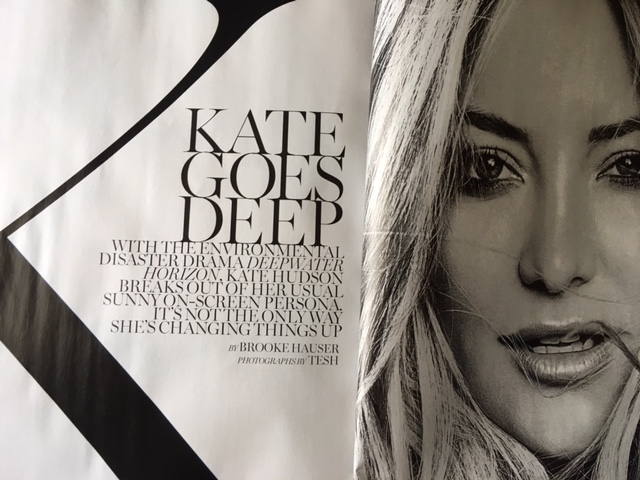
What does it mean to “go deep”? Maybe we’ll learn more about Kate Hudson, beneath her “usual sunny on-screen persona.” It sounds promising: “not the only way she’s changing things up.” What will we learn?
The article opens with a feminist nod via acknowledging the Instagram photo of Kate Hudson reading All About Love, a book written by bell hooks (in the photo, the book is “propped on [Kate’s] bare thigh”). The author chooses a quote from the book to get started; a quote she finds apropos, maybe, to Kate Hudson. “Hudson loves as a verb–actively, consciously,” writes the author. Kate Hudson cuddles and cooks with her sons, meditates with her mom, and hangs out with her long-time gal pal, Meyer. However, Hudson loves alone time, to lock herself in rooms.
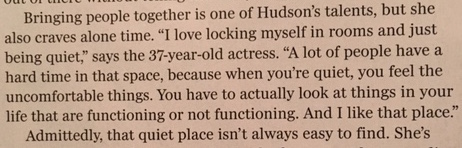
When you’re quiet, you feel the uncomfortable things. This article is starting to make me feel uncomfortable because of how quiet it’s getting with the actual message: we hear from Hudson loving alone time, that she has to lock herself in rooms to get it; we don’t hear of her loving her talent of bringing people together or how this fulfills her. It, of course, fulfills the article, though, and makes for the great story we want Kate Hudson to be.
Again, let’s draw our attention to the tagline on the cover: “What is it about Kate Hudson that makes us love her so damn much?” She’s just like us… we can’t get alone time, we can’t do it all, but no one can know.
The author and Hudson are having lunch at a Japanese restaurant in New York City. While there, Hudson’s phone buzzes, and the author is reminded of the inaugural cover of Ms. magazine. “Swap out the frying pan for a Fendi bag, and it could be Hudson.”
A Fendi bag?
What does that say about her intellect? Oh yeah, her ability to succeed > make money > sacrifice her interior life, her true voice > “business savvy”
I’d almost rather have the frying pan. I would rather learn how to flip an omelet than tote around a designer bag. (Read: Interior vs. Exterior motivation)
With the girlfriend-ness and “confessional” Kate established, its time to move on to her career. Instead of the author summarizing Hudson’s new movie, Deepwater Horizon, she quotes Hudson doing it!
“‘The focus is on the humanity versus the environmental impact…There were a lot of heroes on that rig, but they couldn’t save everybody.'”
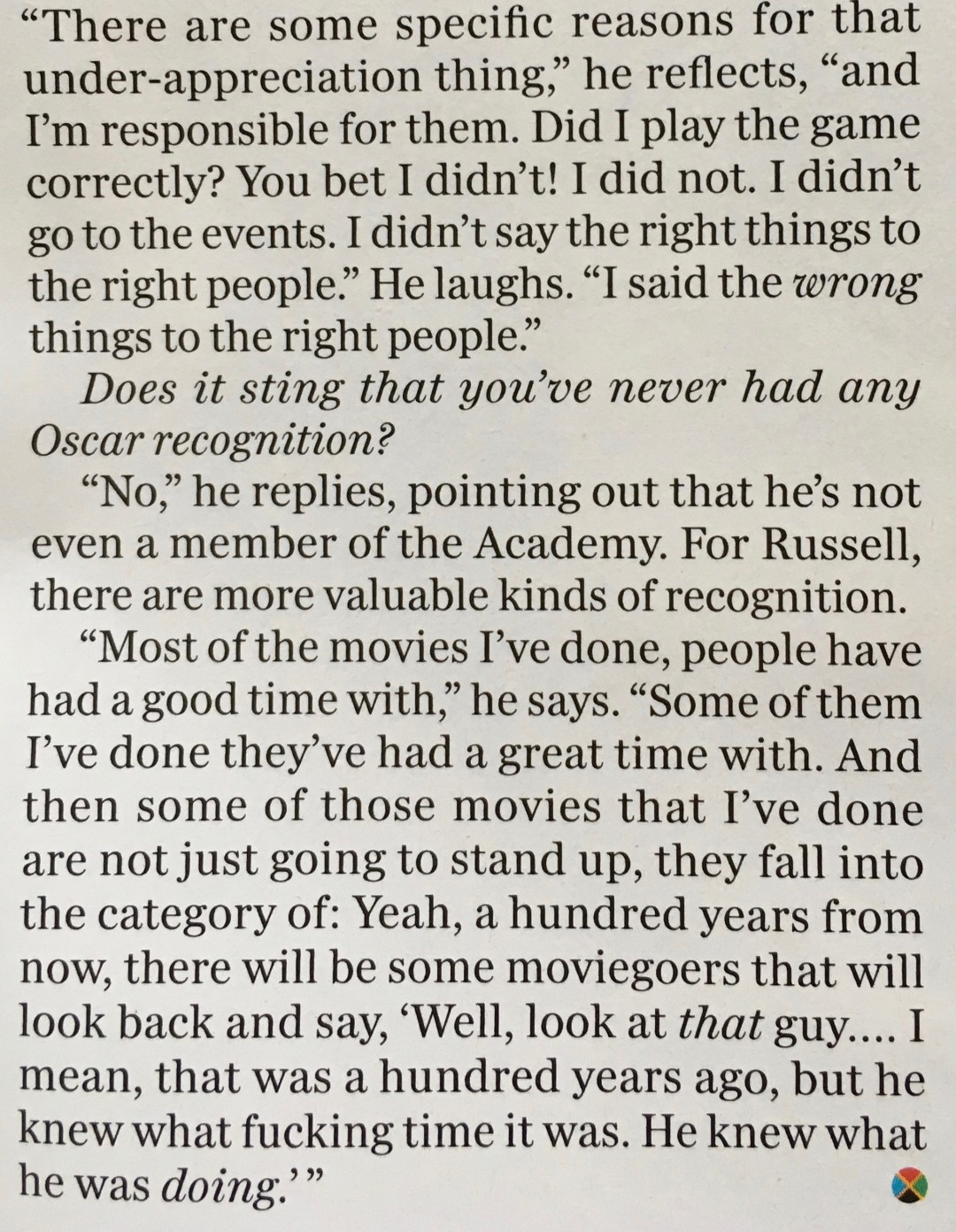
That’s great, but can’t we hear Hudson talk about the impact this takeaway has on her, instead of her doing something the author so easily could have and maybe should have done?? Or can’t we hear from Hudson what it’s like to play a role that’s “a bit of a departure” from her “lighter fare”? We don’t need more people telling it for Kate, but instead, that’s exactly what we get. We get Kurt Russell–not Kate–on Kate’s career.
“Russell believes that [Kate] has a lot more to offer…’Kate’s been very successful in a number of different roles, but the ones that seem to have gotten the most emphasis from the system have not been at the level that I think an actress with Kate’s ability dramatically can benefit from as much as she deserves.'”
Aside from being a wordy quote from Russell, it holds a gem: the system. If I were the interviewer, I’d say, the system? tell me more. But that probably wouldn’t be my call because, you know, the system.
Here’s the best part, the one that got me really reeling, that inspired me to start this blog. I was at a spa and decided to pick up the marieclaire magazine next to me, something I never would have done a year ago, when I was insecure and fearful of any media that would send me off the deep-end into a pit of self-loathing that revolved around food, my ability to eat and not eat it. Here, this “ability” is revered as a talent. It’s praised!! All I could remember from this article, after first reading it, was that Kate Hudson logged 84 calories for her miso soup into her fitness ap. Yes, 84 calories. And this is what the author calls Health.
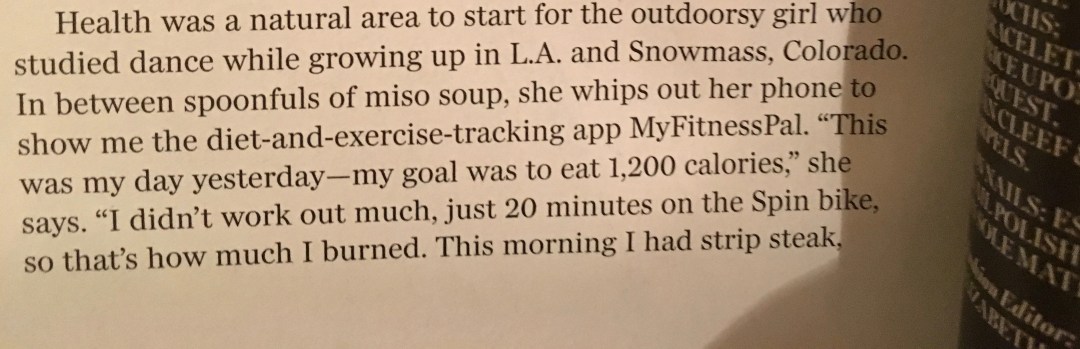
WHY IS IT IMPORTANT TO KNOW THAT KATE HUDSON’S GOAL WAS TO EAT X CALORIES, BURN X CALORIES, AND WHY IS IT IMPORTANT TO KNOW THAT SHE FAILED? WHY IS IT IMPORTANT TO KNOW WHAT SHE ATE THAT DAY, BEFORE SHE ARRIVED AT LUNCH IN HER BACKLESS SHIRT AND RIPPED JEANS?
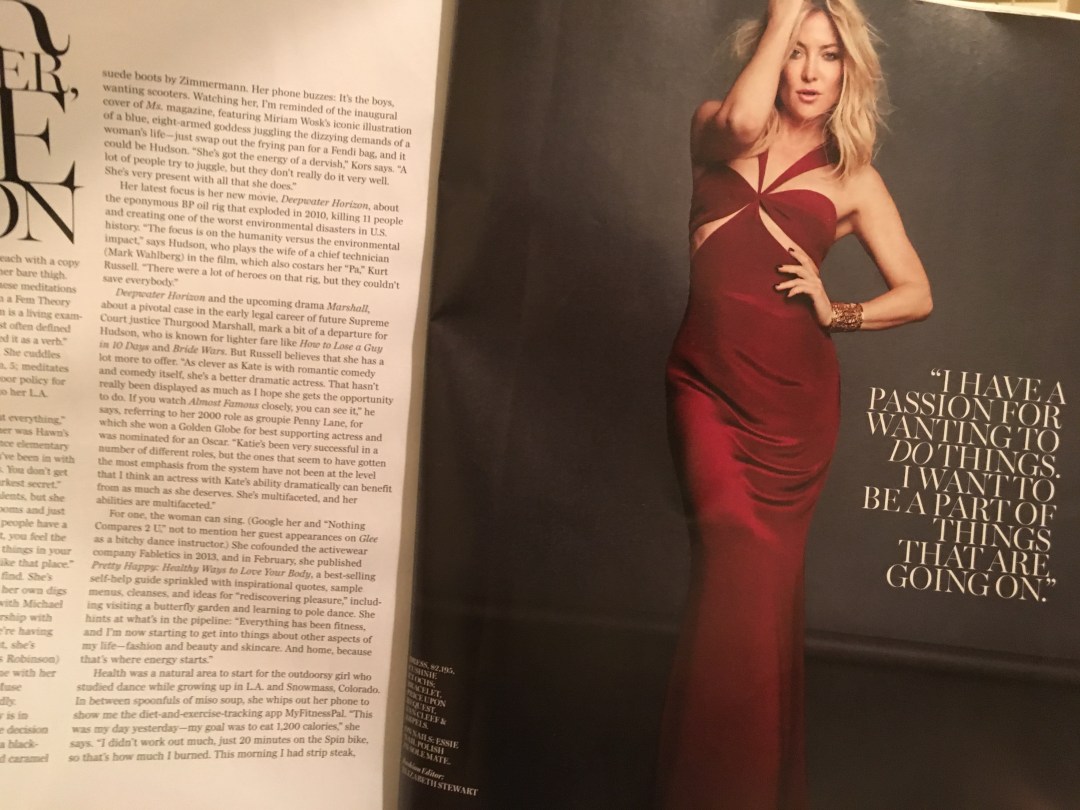
“‘This morning I had strip steak, [comma] [insert photoshopped photo and non-sequitur quote about passion] *TURN PAGE*…about four ounces. Now I’ll add miso soup: 84 calories.'”
*Deep breath*
Next, we learn Hudson likes to read and compose short stories and poems, and that she was “persuaded” to write a fitness and health book. Hudson says, “‘I was like, ‘Why would I write a book? Does anybody really want to know what I think?””
Maybe we do, Kate, maybe we do.
“‘If you don’t want to get criticized,” she says, “do nothing. I would love to be able to pass on to the next generation the need to stop judging everybody so much.'”
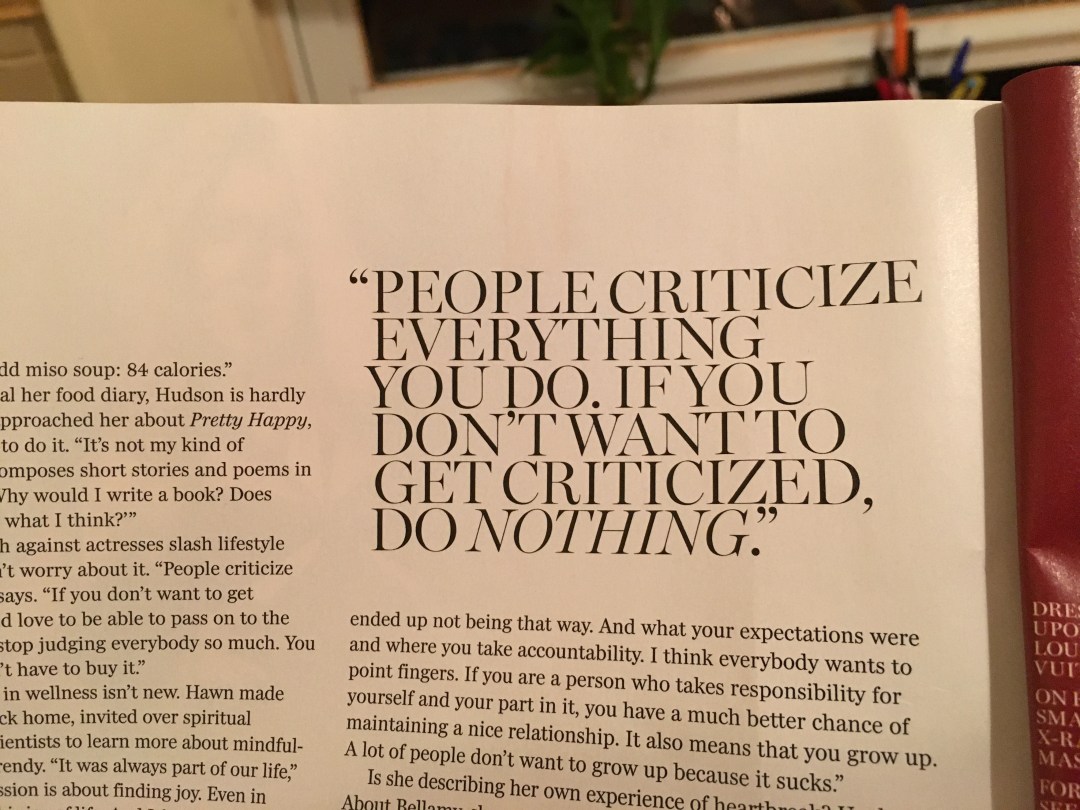
Now, taken out of context, this block is ambiguous. It neither asserts nor rejects. What it does do is imply that we should just shut up, count calories, and write books we don’t want to write. That nothing should be taken literally.
Next, we hear from Hudson’s “best friend since elementary school”, Meyer, who is introduced briefly in the beginning as the gal pal who gets in on Hudson’s deepest, darkest secrets. Meyer recalls that Hudson in high school was “‘the girl who got sent home for wearing her dress too short–her tush was actually hanging out.'”
WHY IS THE DETAIL OF HER TUSH HANGING OUT IMPORTANT??
(Read: OK, she liked to wear short skirts)
Do gal pals tell other gals and magazine editors about each other’s tushies hanging out? If they do, what purpose does that have? To assert that gal pals aren’t trustworthy? We learn from Meyer that Hudson turned down movie roles while she was in high school because, according to Meyer, “She was in no rush to go beyond her years. (Read: OK, she was not a slut). She was always ready for a good time. (OK, she was a slut). She was always the girl everybody wanted to hang out with. (Yep, probably).
A nearly-redeeming part of this article is when Hudson is quoted on view of her presidential candidate Hilary Clinton: “‘There’s so much focus on her likability. I want to elect a president to get the job done…as a woman, and as a working mom trying to get things done, you find yourself meeting adversity a lot, but you never talk about it because you don’t want to bring attention to it. You don’t want to go there.'”
“You find yourself meeting adversity a lot, but you never talk about it because you don’t want to bring attention to it. You don’t want to go there.'”
And what is the purpose of this article? To maintain, not disembody, what it is about Kate Hudson that makes us love her so damn much.
…
Likability.
Which is why we won’t hear about adversity.
Why we don’t have access to Kate Hudson’s poems.
Which is why, when she asks, “Does anybody really want to know what I think?”
she means it.
And yes, we want to know,
Beyond what you eat and how many calories you burn. Beyond the male costars that overshadow. Beyond your relationship advice, your love-life and motherhood struggles (which is what the last 4 major paragraphs of the article are about).
We get all that. Too much of it, in fact.
Yes, our relationships–with food, with work, with people–may define us. But our identities are amorphous. We must break out of old shells to celebrate the process of the breaking. We will not settle for old containers designed by the system to appear new. They are the same, in disguise. And we must break, break, break. It is our responsibility, as writers, as thinkers, as human beings, to break.
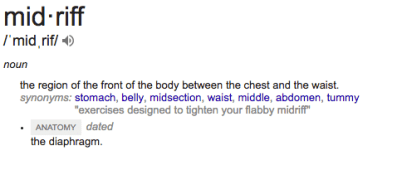 “Exercises designed to tighten your flabby midriff.” Well, gee. Couldn’t there have been other ways to contextualize midriff? Abdominal exercises are designed to tighten your midriff. Bikinis are swimsuits that bare the midriff.
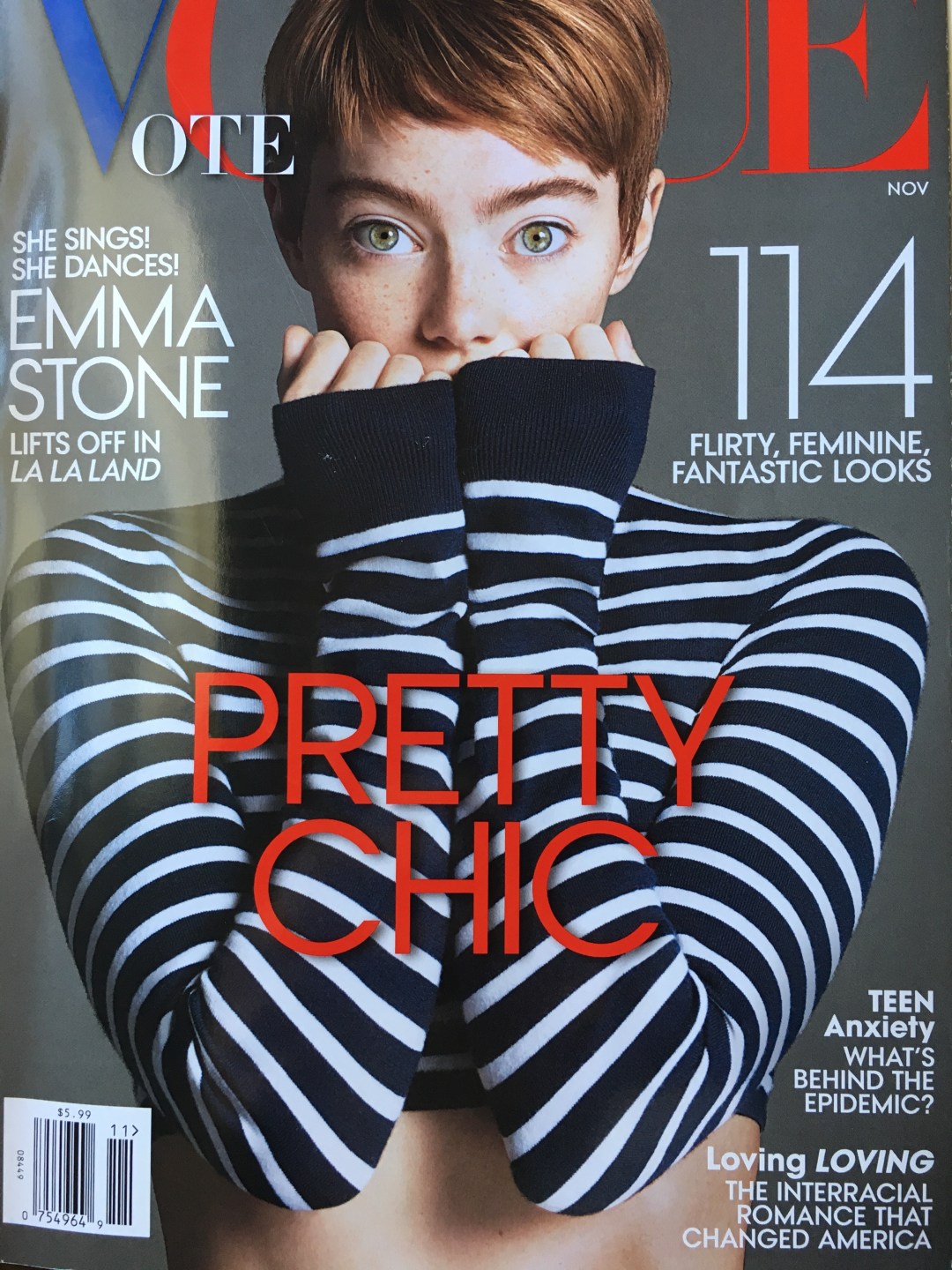
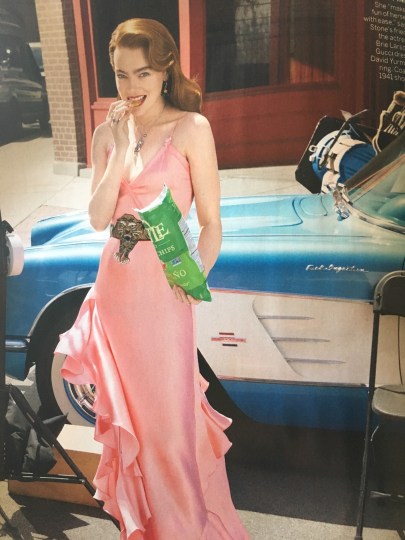
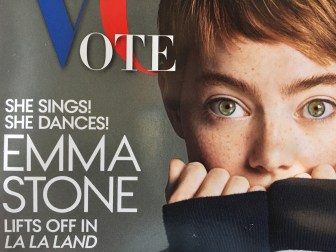 appears to be tight on the cover and in all the pictures included in the cover story article. We wonder, though, why is she looking super afraid and shy next to the text that describes her talents? A girl who hides her face wouldn’t seem like the kind of girl who would sing! and dance! She seems self-conscious. If she’s self-conscious, she might not wear a crop-top. Emma Stone silencing herself seems fake, especially when we learn she can make fun of herself with ease…be authentically herself…be a doll and a badass. Wouldn’t she make fun of her shyness, not pretend she has something to hide? The cover photo is misleading. We don’t see a confident woman. We see a shy girl.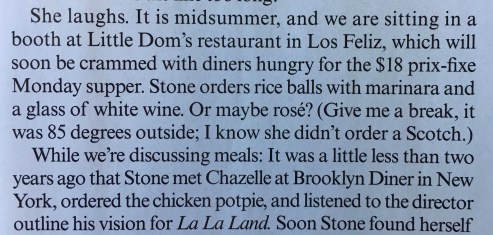













 Is The Message