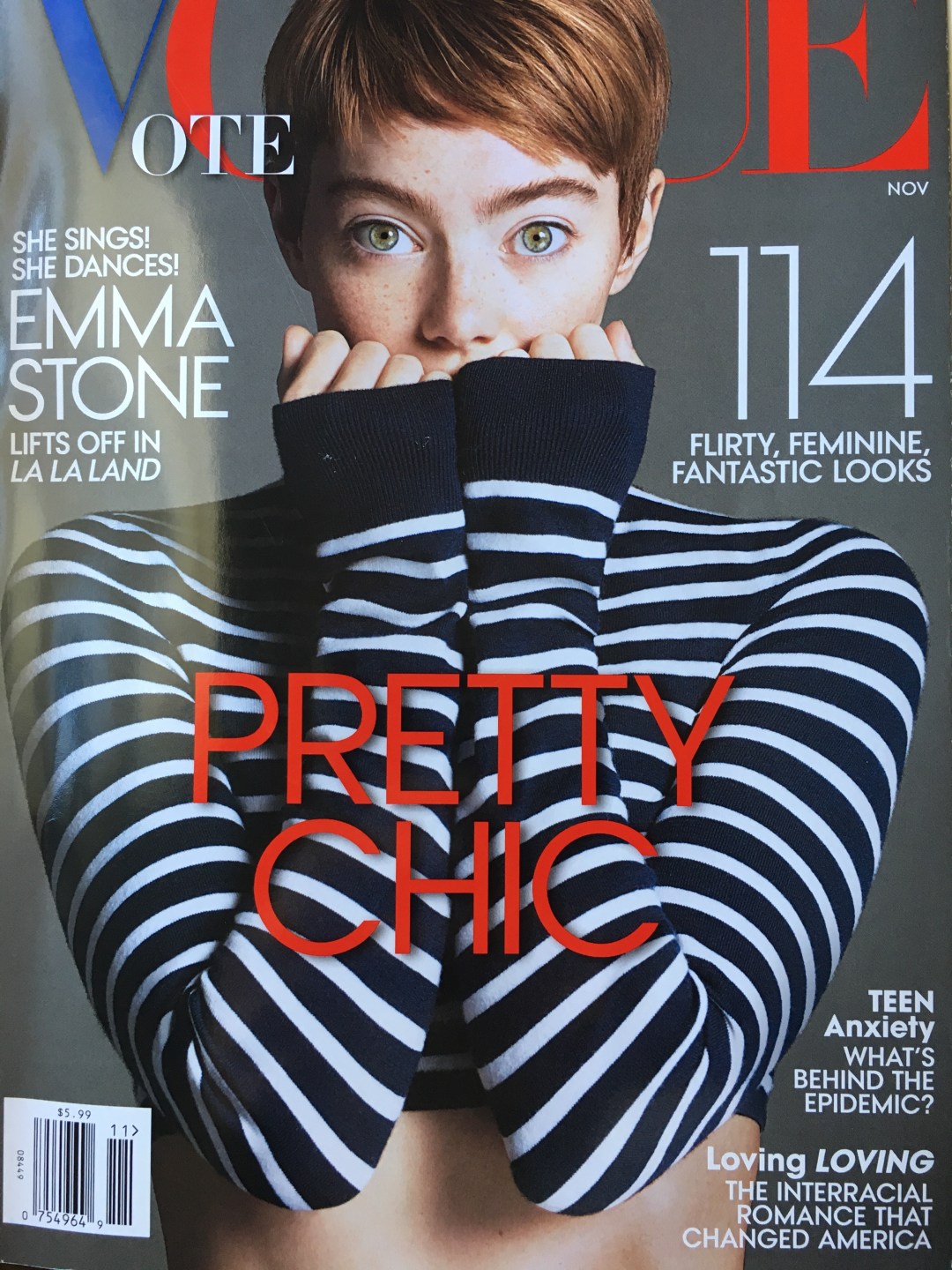
We decided to take a more tactical approach this month by asking a hairdresser in her mid-40s who works at an upscale salon her favorite magazine. “Vogue,” she said. “It was like my Bible growing up. I’m a Vogue girl.”
As novices to Vogue, we decided to approach this issue with, as always, an objective point of view. The cover looked promising; it had something we could sink our proverbial analytical teeth into: a girl with wide eyes, covering her mouth, in a midriff top.
Fun aside: when you google the word “midriff” here’s what you get:
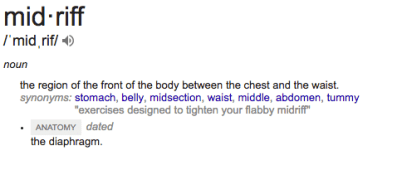 “Exercises designed to tighten your flabby midriff.” Well, gee. Couldn’t there have been other ways to contextualize midriff? Abdominal exercises are designed to tighten your midriff. Bikinis are swimsuits that bare the midriff.
“Exercises designed to tighten your flabby midriff” isn’t even full sentence. But anyway.
Needless to say, Emma Stone’s midriff 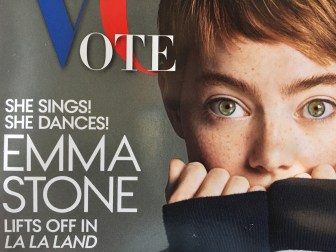 appears to be tight on the cover and in all the pictures included in the cover story article. We wonder, though, why is she looking super afraid and shy next to the text that describes her talents? A girl who hides her face wouldn’t seem like the kind of girl who would sing! and dance! She seems self-conscious. If she’s self-conscious, she might not wear a crop-top. Emma Stone silencing herself seems fake, especially when we learn she can make fun of herself with ease…be authentically herself…be a doll and a badass. Wouldn’t she make fun of her shyness, not pretend she has something to hide? The cover photo is misleading. We don’t see a confident woman. We see a shy girl.
What’s additionally troubling about this cover story is the repeated focus on the food Emma Stone orders and presumably eats. The author and Stone get together for lunch. Stone orders rice balls and wine, and she and the author (?) discuss meals:
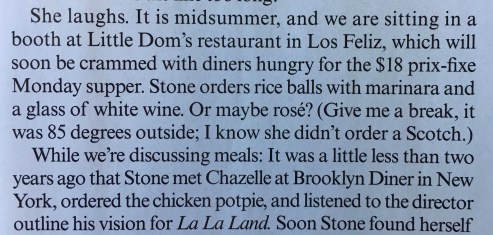
Or does the author mean, “while me and you (the reader) are discussing meals”? Either way, the later mention of “chicken pot pie” is superfluous, but apparently it must be important since it made the article’s word count.
Placing norms and constrictions on authenticity just make it seem like a caricature of itself and therefore something, yet again, unattainable.
The article praises Emma Stone for her “vast comedic and dramatic talents” while also being “vulnerable, relatable, self-deprecating.” So when Stone and the author build a teddy bear at Build-a-Bear; or visit a bowling alley–where Stone orders pizza and beer–and bowl badly, it’s endearing, just like it is to know that Emma Stone eats carbohydrates, and (maybe) a potato chip from the bag.
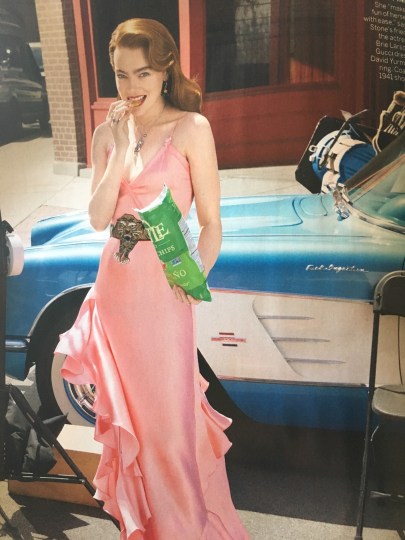
The gratuitous mention of comfort foods makes us wish the author would have described Emma slugging a beer or chewing a mouthful of cheesy bread.
While this article celebrates Emma Stone’s career and personality more than marieclaire did for Kate Hudson, it contradicts itself with exaggerations of what co-actors and friends love about her the most: that she is flawless, yet flawed. She has worked hard, but there is always a risk of losing it all. She balances on the beam of self-control with poise and attitude. She is represented as an ideal we are not told how to live up to. Be pretty and quiet like a doll, but also be bold. Hide your face but shine on the dance floor. Eat, but don’t get fat. Placing norms and constrictions on authenticity just make it seem like a caricature of itself and therefore something, yet again, unattainable. Our dare to you is to quit looking outside of yourself to find what’s truly you. Which may be why Vogue was never our Bible.
 Is The Message