When Gardasil, the HPV vaccine, was announced to the public in 2006, it felt too fast, too soon. Friends who got the vaccine wondered why anyone wouldn’t. It seemed great, the new precautionary trend, but we were being fed what we wanted to believe: that we were protecting ourselves from a virus we didn’t know enough about. Our ability to swallow beliefs allows companies to create markets out of thin air.
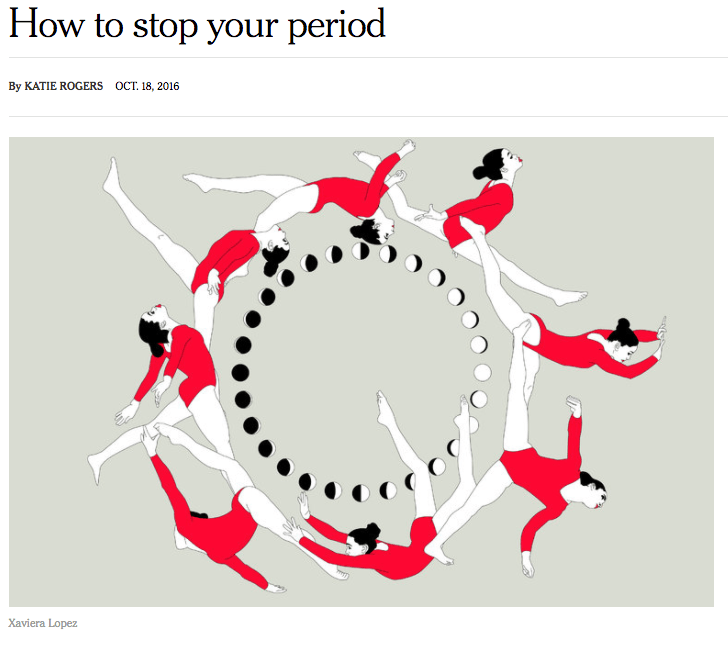
On October 2016, The NYT ran an article called “How to stop your period.” Maybe, I thought, there’s a healthy way to do it that’s not starving or over-exercising. “Healthy”, to me, means living as close as possible to nature with the smallest possible amount of medical intervention when need be. The key term here is “need.”
Many women may not need to suppress their periods, but many women may choose to do so out of the sheer convenience some articles portray as the result. The NYT article is fairly balanced, however, the author is a proponent of contraception herself, and every argument that is for period suppression states that women who are already on contraception are already having synthetic periods, and this is just the next “step up” in the lifestyle.
While researchers are “studying how fewer periods can help improve quality of life for women in extreme employment situations,” they are not studying the effects on bone health, heart health, cancer risks, and fertility, nor are they studying the effects of period suppression in adolescent and young women, whose bodies are still maturing.
Just because a new technology is available doesn’t mean it’s safe or right.
In a search for more answers to the question of whether or not it’s safe to not have a period, this website, verywell.com, pretends to answer it by saying that women who are already taking contraception are already exposing themselves to certain risks, and the “period” they get while on placebo isn’t a period but “withdrawal bleeding” which is not medically necessary. In short, it’s OK not to have withdrawal bleeding. But what about an actual period? Women who don’t get regular (without contraception) periods are medically advised to see a doctor. That’s something we learn in health class. But what about young women in their teens and early 20s who decide to stop their periods just because they can? What else are they unknowingly changing or stopping?
Just because a new technology is available doesn’t mean it’s safe or right. That would be like believing everything on TV. When a product is available to the public, it is susceptible to fault. The public is made up of individuals, but the private corporation treats it as one body that can be manipulated, and sells its product as the cure.
Who knows whether the folks who made and sold Gardasil knew that it could kill young women. Nevertheless, the priority was to get it sold. And many people were.
Overall, on verywell.com, their biased view is that period suppression “can serve as a great convenience for women with busy and active lifestyles.” Any suggested related article you click takes you to another that recites just this, albeit in different words.
Finally, after more Google searching, I came across this enlightening chunk of text on Womensenews.org:
“Women have been so overwhelmed with negative messages about the inconvenience of menstruation we are willing to take a synthetic chemical cocktail to eliminate the monthly cycle, the foundation of our womanhood,” writes author Leslie Botha. This article was published 10 years ago, a few months after Gardasil launched its marketing campaign, and came to win several advertising and marketing awards.
It is evermore vital to doubt, to question, before you say yes or no to anything anyone recommends for your body. If it sounds too good to be true, it most likely is. Ask yourself whether they’re playing on your fear, and if that fear is based, if there’s an imminent need or threat, or if it’s just a phantom at your door.
 Is The Message